
DEA Registers 900+ Medical Marijuana Dispensaries: What Patients Need to Know

Updated: 11 minutes ago
Something Historic Just Happened in U.S.
On October 30, 2026, the U.S. Department of Justice announced that the Drug Enforcement Administration is moving forward with federal registrations for more than
900 state licensed medical marijuana dispensaries.
One of the Biggest Federal Medical Marijuana Changes Since 1937
The First Registrations are Going to Qualifying Dispensaries in Only a Few States
Alabama
Florida
Mississippi
South Dakota
Texas
Virginia
West Virginia

For medical marijuana patients, that naturally raises a big question:
Does this mean medical marijuana is now federally legal?
Not exactly. But it does represent one of the most significant changes in the relationship between federal law and state medical marijuana programs in decades.
Here is what patients should understand.
What Did the Federal Government Actually Do?
In April 2026, the Department of Justice placed certain marijuana products connected to qualifying state medical marijuana programs under Schedule III controls of the federal Controlled Substances Act.
That included marijuana products regulated through qualifying state medical marijuana licenses, along with FDA approved marijuana products.
Now the DEA has begun the next major step: actually registering qualifying state licensed medical marijuana businesses under the new federal framework.

The October 30 announcement covers more than 900 dispensaries in the first phase.
Official DOJ announcement:
DEA marijuana regulatory information:
Why Is This Such a Big Deal?
For decades, patients have lived under two very different systems.
A state could authorize medical marijuana.
A physician could certify a qualifying patient.
A patient could obtain a state issued medical marijuana card.
A state licensed dispensary could legally sell medical cannabis under state law.
Yet federal marijuana law remained dramatically different.
The new federal framework creates, for the first time, a pathway for qualifying state licensed medical marijuana businesses to operate with DEA registration under Schedule III controls. David Koyle, CEO, OMNI Medical Services
That does not erase all federal marijuana restrictions.
But it creates a level of federal recognition and oversight that state medical marijuana programs have never previously had on this scale.
Does This Mean Medical Marijuana Is Federally Legal Everywhere?
No. This is the most important distinction for patients.
The Attorney General’s order applies to defined qualifying medical marijuana activities.
It does not broadly legalize marijuana nationwide.
It does not legalize recreational marijuana.
And marijuana activities outside the qualifying federal medical framework can still remain subject to Schedule I controls.
The DOJ specifically emphasized this distinction when announcing the registrations.
So patients should not interpret the headline as: “Marijuana is now federally legal.”
That is not what happened.

What Is Schedule III?
The Controlled Substances Act divides controlled substances into several schedules.
Schedule III substances are federally controlled.
But they are treated differently from Schedule I substances.
The April 2026 federal action placed certain qualifying medical marijuana products into Schedule III while maintaining additional federal controls.
That means the federal government is now treating qualifying medical marijuana activity differently from marijuana activity that remains outside the new medical framework. David Koyle, CEO, OMNI Medical Services
The DEA continues to regulate the businesses involved.
Why Did Only Seven States Receive the First Registrations?
This is another question many patients are asking.
Why Florida?
Why Alabama?
Why Texas?
Why not every medical marijuana state?
The answer is that this is only the first phase.
The DEA began with dispensaries that:
Operate under qualifying state medical marijuana regulatory systems
Applied during the initial federal application period
Met applicable federal requirements
Successfully completed the DEA’s preregistration review
A state medical marijuana license alone does not automatically produce a DEA registration.
The federal government is reviewing applicants individually and issuing registrations in phases.
More registrations are expected.

Why Is Florida Included?
Florida is particularly important because it has one of the country’s largest regulated medical marijuana patient populations and a mature state medical cannabis system.
Florida businesses participated heavily in the federal registration process.
The DEA is now granting registrations to qualifying Florida dispensaries as part of this first federal group.
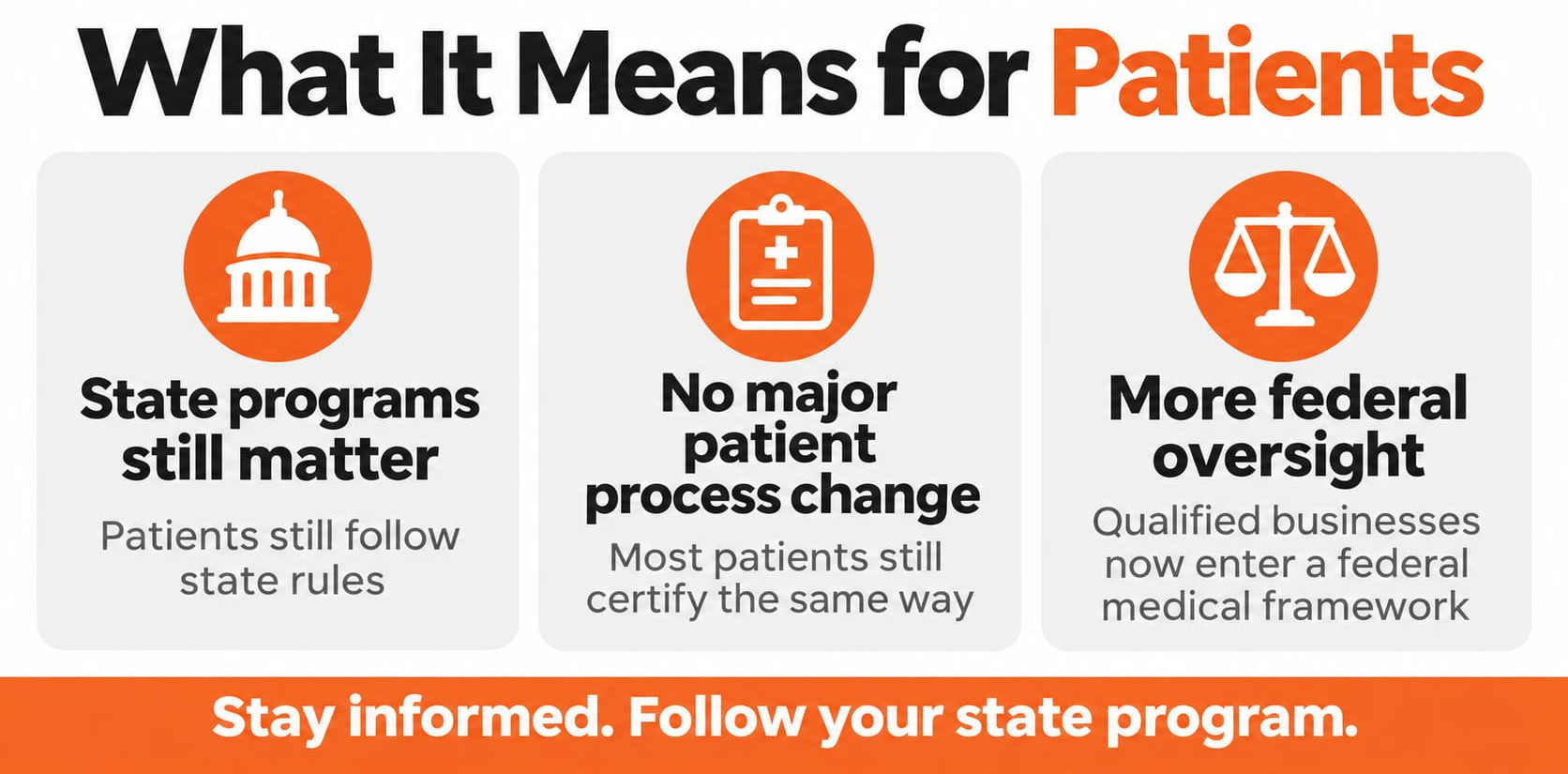
For OMNI patients in Florida, this does not change the basic patient certification process overnight.
You still need to follow Florida’s medical marijuana laws and Medical Marijuana Use Registry requirements.
Learn more about OMNI medical marijuana services in Florida:
What About Ohio and Michigan?
Ohio and Michigan are not among the seven states named in the first group of more than 900 registrations.
That does not mean their medical marijuana programs suddenly became invalid or that patients there lost access.
Their state medical cannabis systems continue to operate under applicable state law. The DEA has described this as a phased federal registration process, and additional applications continue to be reviewed.
OMNI patients should continue following their own state’s current rules.
Ohio:
Michigan:
Will Patients Notice Anything Different at the Dispensary?
For many patients, probably not immediately.
This change is primarily about the federal legal and regulatory status of qualifying medical marijuana businesses.
DEA registered dispensaries will have federal requirements involving areas such as:
Security
Recordkeeping
Inventory controls
Controlled substance handling
Supply chain compliance
Patients may not see those systems operating behind the scenes.
However, over time, federal oversight could influence how participating medical marijuana products are produced, distributed, tracked and sold.
Could This Affect the Medical Marijuana Supply Chain?
Yes.
And this may be one of the most important short term effects. DEA registered businesses are subject to federal rules governing whom they can legally conduct Schedule III medical marijuana transactions with.
The agency is also reviewing applications from manufacturers and distributors that supply dispensaries.
Those businesses face additional federal review, including inspections, production controls and quota requirements.
That means the federal registration system is not simply about the dispensary at the end of the chain. The DEA has given affected businesses time to bring supply relationships into compliance with the new framework.
For patients, that means the biggest short term question may be whether the transition causes changes in product availability or supply relationships in participating markets.
Does This Change How You Get a Medical Marijuana Card?
For most patients, no immediate change.
Medical marijuana patient certification still operates primarily through state medical cannabis programs.
Patients still need to meet their state’s current eligibility and certification requirements.
For OMNI patients, that means following the rules of the state where you are registered.
OMNI currently serves medical marijuana patients in Florida, Ohio, Michigan, Pennsylvania, Illinois and Kentucky.
Does This Mean Recreational Marijuana Is Schedule III Too?
No.
The Justice Department has been explicit about this.
The new framework applies to qualifying medical marijuana activities.
It does not authorize adult use or recreational marijuana.
Marijuana outside the qualifying medical framework may remain subject to Schedule I federal controls.
This distinction is especially important in states that operate both medical and adult use cannabis markets.
Is All Marijuana Now Schedule III?
No.
This is where many headlines can become misleading.
The federal government has created a Schedule III framework for particular qualifying medical marijuana products and activities.
At the same time, the broader federal proceeding concerning marijuana’s overall scheduling status is a separate process.
Those two issues should not be confused. The DEA continues to maintain a separate administrative process involving broader marijuana rescheduling.
Could This Lead to More Medical Marijuana Research?
Yes. Potentially.
Research has long been one of the central arguments for changing marijuana’s federal status.
Schedule III treatment can remove or reduce some barriers associated with Schedule I research, although researchers must still comply with federal requirements.
More standardized federal oversight may also eventually provide researchers with better information about product composition, safety, dosing and medical outcomes.
For patients, better research could ultimately mean better answers to questions such as:
Which conditions respond best?
What dose is appropriate?
What are the risks of THC?
How does cannabis interact with prescription medications?
What role might CBD play?
Which delivery methods are safest?
How does cannabis affect older adults?
Those are exactly the kinds of questions patients and medical professionals need better evidence to answer.
Could Federal Registration Improve Patient Safety?
Yes. That is one of the goals of the federal system.
DEA registered dispensaries will be expected to follow federal requirements concerning security, recordkeeping and inventory control.
Manufacturers and distributors seeking registration face their own regulatory requirements.
Whether this ultimately improves patient safety will depend on implementation, enforcement and coordination between federal and state regulators.
But the direction is significant:
Medical cannabis is increasingly being treated as a regulated medical system, rather than simply an exception created by individual states.
Does This Change Federal Employment, Firearm, Travel or Immigration Rules?
Patients should be very cautious about assuming it does.
Federal marijuana law touches many areas beyond state medical marijuana programs, including:
Employment
Federal property
Interstate transportation
Airports
Firearms
Immigration
Federal benefits
Drug testing
The new dispensary registrations should not be interpreted as automatically changing every federal policy involving marijuana.
Patients should continue to follow applicable federal and state law and seek appropriate legal advice when a specific issue could affect employment, travel, immigration, firearms or other legal rights.
What Should Medical Marijuana Patients Do Right Now?
For most patients, the answer is simple:
Do not change anything based solely on the headline.
Continue following your state’s medical marijuana program.
Keep your physician recommendation or certification current.
Maintain your state registration where required.
Purchase medical cannabis through properly licensed businesses.
And pay attention as federal and state regulators clarify how this new system will work.
What Happens Next?
The DEA says registrations will continue through a phased process.
The agency is also reviewing applications from medical marijuana manufacturers and distributors.
Those applications may take longer because the federal government must evaluate facilities, production controls and other regulatory requirements.
Meanwhile, the broader federal marijuana rescheduling proceeding remains separate.
In other words:
October 30 Was a Major Step — Not the End
More than 900 state licensed medical marijuana dispensaries are entering a federal DEA registration system.
That is significant!
But patients should understand what it does and does not mean.
It does not mean recreational marijuana is federally legal.
It does not mean every medical marijuana dispensary is federally registered.
It does not eliminate state medical marijuana programs.
And it does not instantly change how most patients obtain their medical marijuana certification.
What it does represent is something historically important:
The federal government is now directly registering qualifying state licensed medical marijuana dispensaries under a Schedule III medical framework.
For patients, the most important thing right now is to stay informed while continuing to follow the rules of their state medical marijuana program.
Find an OMNI Medical Marijuana Doctor
OMNI Medical Services helps patients understand medical marijuana certification and renewal requirements in several states.
Florida:
Ohio:
Michigan:
Pennsylvania:
Illinois:
Kentucky:
Book an OMNI medical marijuana evaluation

Official Sources
U.S. Department of Justice — October 30, 2026 announcement:
U.S. Department of Justice — April 23, 2026 Schedule III announcement:
DEA Marijuana Rescheduling Regulatory Actions:
Medical and Legal Disclaimer
This article is provided for general educational purposes only and is not individualized medical or legal advice. Federal and state marijuana laws continue to evolve. Medical marijuana patients should follow the requirements of their state program and seek appropriate professional guidance regarding medical treatment, employment, travel, firearms, immigration or other legal questions. Information in this article was reviewed against U.S. Department of Justice and Drug Enforcement Administration information available as of November 2, 2026.


Comments